Bottom line up front
NVIDIA says it is working with Apollo, BlackRock, Blackstone, Brookfield, Goldman Sachs and KKR on financing platforms designed to mobilize more than $500 billion of third-party capital for AI infrastructure over time.
That number is aggregate platform capacity, not a funded vehicle or an NVIDIA revenue commitment. The more important development is structural: AI factories are being packaged for infrastructure capital, with project-level underwriting of customer quality, utilization, cash flow and residual value.
A GPU is the visible asset. The contract is what makes it lendable. For neocloud investors, the winning metric is no longer contracted gigawatts. It is debt service coverage after power, utilization and refresh.
The week compute got a capital market
The AI infrastructure trade has spent three years asking whether demand is real and whether enough power can be energized to serve it. This week added a third question: can the resulting cash flows be financed like infrastructure?
NVIDIA's answer is yes, conditionally.
On August 10, Jensen Huang announced partnerships with six of the largest names in private capital. The stated objective is to create financing platforms capable of mobilizing more than $500 billion of third-party capital over time for what NVIDIA calls AI factories.
The qualifiers matter. The figure is the aggregate capacity of the platforms, not a single fund, a commitment to one customer or booked NVIDIA revenue. The institutions will independently underwrite customer quality, demand, utilization, cash flow and residual value. NVIDIA may provide residual-value support of up to 25% of an opportunity, assessed project by project. That support complements the underwriting. It does not replace it.
This is not merely more money chasing GPUs. It is the beginning of a capital structure around compute.
Apollo supplied an earlier proof point in June. It led an initial $35 billion capital solution for Broadcom's AI XPV platform, alongside Blackstone and global banks. The first deployment supports more than one gigawatt of capacity for Anthropic, with the platform designed to enable more than 20 gigawatts by 2028. Apollo described the emerging asset class in the language of infrastructure credit: contracted cash flows, mission-critical utility and favorable supply-demand conditions.
That language tells us what changed. The chip is not being financed on scarcity alone. It is being financed as one component of a contracted, powered and operating system.
A GPU is not the collateral thesis
A scarce GPU can still be weak collateral.
It can arrive before the building is ready. It can sit behind an interconnection delay. It can be installed for a customer whose contract does not survive the debt term. It can run below utilization assumptions, consume more power than expected or lose rental value faster than the principal amortizes.
The object can be valuable while the loan around it is poor.
What makes an AI factory financeable is the stack around the hardware:
- A creditworthy customer commits to enough revenue, for long enough, to support the project.
- Power, land and cooling are available on a schedule that matches the financing draw.
- The system is delivered and accepted, which turns construction risk into operating cash flow.
- Utilization and operating margin cover interest, amortization and maintenance.
- The equipment retains enough useful life or redeployment value to protect the downside.
The GPU is the visible asset. The contract is what makes it lendable.
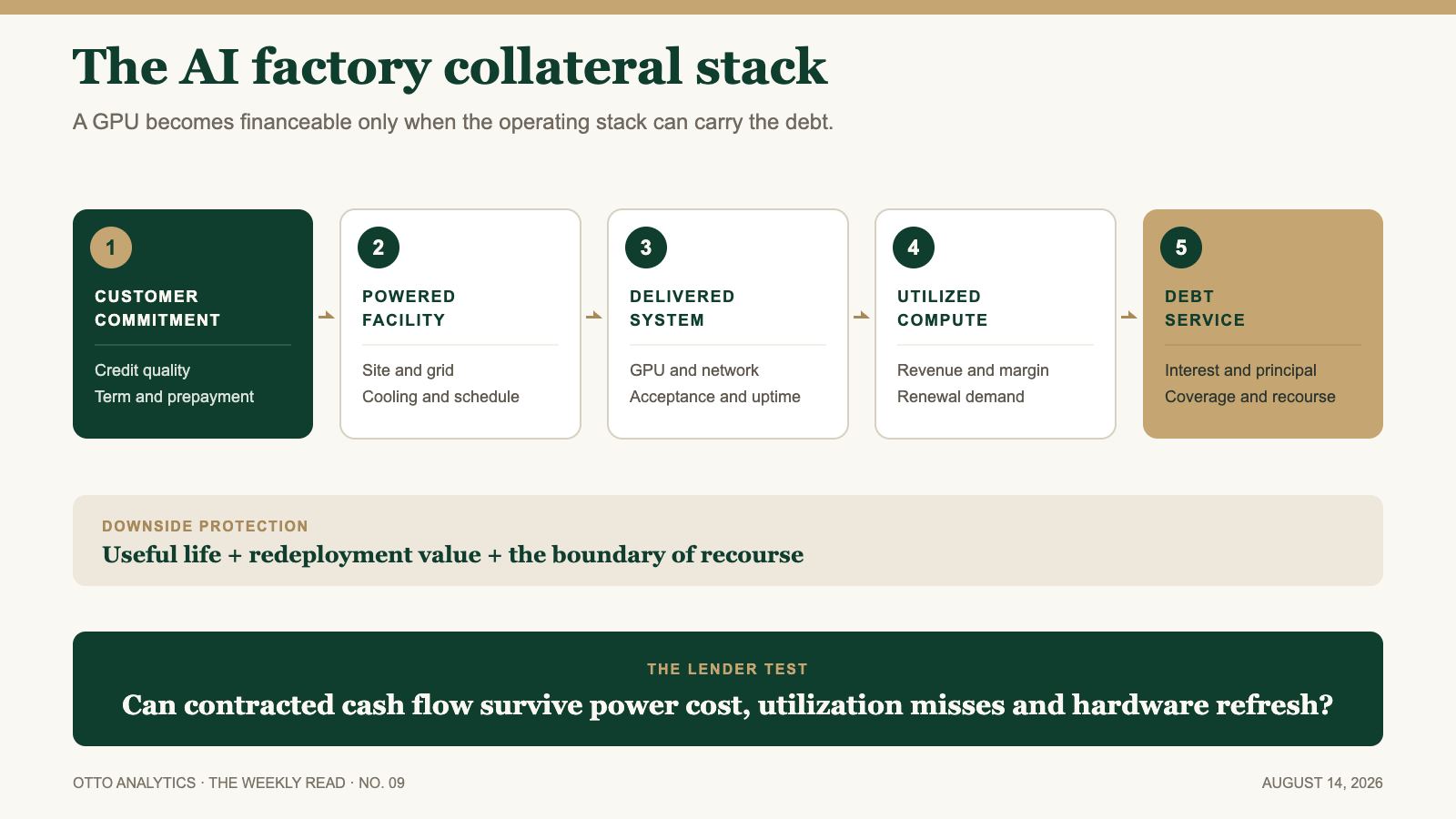
The financeable asset is the whole operating stack. A lender is underwriting whether contracted cash flow can survive power cost, utilization misses and hardware refresh, not simply whether the GPU has a resale price.
CoreWeave shows what the model looks like at scale
CoreWeave is the cleanest public example of this structure in motion.
Its second-quarter filing reported $2.575 billion of revenue, $1.510 billion of adjusted EBITDA and a $49 million GAAP operating loss. Net interest expense was $640 million for the quarter. Backlog stood at roughly $104 billion at June 30, before more than $25 billion of additional commitments signed early in the third quarter. Active power reached about 1.5 gigawatts and contracted power about 3.7 gigawatts.
The demand is visible. So is the financing burden.
During the first six months of 2026, CoreWeave purchased $14.117 billion of property and equipment and issued $16.747 billion of debt. Its delayed-draw term loans are structured around the assets and cash flows of specific projects. The company says those facilities are collateralized by assets underlying contributed contracts and pledged contractual cash flows, generally from investment-grade counterparties. Draws occur as infrastructure is built, and amortization follows as contracted cash flow is generated.
That is the model in one sentence: customer paper turns a GPU cluster into financeable infrastructure.
It is also why the headline backlog is not enough. CoreWeave notes that backlog remains subject to delivery and availability requirements. A signed customer can support the borrowing base, but only if the company can energize, deliver and operate the capacity on time. Until then, the contract is an obligation on both sides rather than realized cash flow.
The same filing shows how project details change the equity outcome. One delayed-draw facility is non-recourse apart from customary carve-outs and carries pricing around 2.25 percentage points over SOFR for floating-rate loans. Another carries pricing around 4.50 percentage points over SOFR and is guaranteed by CoreWeave. Both can fund GPU infrastructure. They do not assign the same risk to shareholders.
Demand gets the contract. Financeability decides whether shareholders keep the economics.
Why NVIDIA may win twice
NVIDIA already earns when the system is sold. A functioning capital market could help it earn again by expanding the pool of buyers capable of funding the system.
That is the strategic value of the financing partnerships. They can convert demand that is operationally credible but balance-sheet constrained into orders that can be built. They may also reduce the gap between a customer's desire for compute and a neocloud's ability to finance it.
Residual-value support matters for the same reason. Lenders care about the value left after a contract ends or a borrower fails. NVIDIA argues that its systems are fungible, can be redeployed across customers and benefit from a long CUDA-supported useful life. Its willingness to support up to 25% of an opportunity can help absorb some of that uncertainty.
But the support is deliberately limited. It is not a blanket floor under GPU prices, a guarantee of operator margins or insurance against an uneconomic power contract. The capital providers still have to underwrite the project, and the operator still has to execute it.
NVIDIA is widening the financing channel. It is not making every borrower financeable.
The neocloud sorting mechanism
The new capital is likely to widen the gap between operators rather than lift all of them equally. We would sort the market through six gates.
1. Contract quality
Who is paying, for how long and with what termination rights? A multiyear commitment from an investment-grade customer supports a different borrowing base than short-duration demand from smaller counterparties. Prepayments and minimum commitments matter because they move funding risk away from the operator.
2. Time to service
How many months separate a signed contract from an accepted, billable system? Land, interconnection, transformers, cooling and networking all sit between backlog and revenue. A delay can create interest expense before it creates cash flow.
3. Utilization after the anchor term
Does the site remain useful when the first contract expires? A system designed around one customer can produce attractive initial economics and weak residual economics. Redeployment value depends on location, power cost, network connectivity, software compatibility and the depth of replacement demand.
4. Debt service coverage
What remains after power, operating cost, interest and amortization? Adjusted EBITDA is not the same thing as cash available to equity when the asset base must be financed and refreshed. The better measure is debt service coverage at realistic utilization, not at nameplate capacity.
5. Refresh burden
Does the debt amortize faster than the hardware loses economic value? A GPU can remain technically useful for years and still lose premium rental economics when a more efficient generation arrives. Performance per watt matters because power is often the fixed constraint.
6. Risk allocation
Which obligations sit at the project and which return to the parent? Non-recourse debt can isolate a failed project. Guarantees, completion support and cross-collateralization can move the same failure back onto corporate equity. The rate matters, but the boundary of recourse can matter more.
Where the return migrates
The financing platforms are good news for the volume of AI infrastructure. They are not automatically good news for every layer's margin.
More available debt can increase demand for GPUs, networking, switchgear, cooling and power. It can also increase competition among operators for the same customers and sites. If hardware becomes easier to finance, access to capital becomes less differentiating. The scarce advantage moves toward customer credit, energization speed, low-cost power, operating reliability and disciplined risk allocation.
That changes how we read the ecosystem.
For NVIDIA, broader financeability can expand the addressable order book and strengthen its platform role. For infrastructure lenders, contracted compute offers a new pool of long-duration assets, but one with faster technology change than conventional power or transport infrastructure. For neoclouds, the opportunity grows at the same time the underwriting gets less forgiving. For hyperscalers, better-financed external capacity creates another tool for meeting demand without placing every asset directly on their own balance sheets.
The return should migrate toward whoever controls the hardest-to-replace part of the stack and finances it with the least fragile liability.
What would strengthen, weaken or break the thesis
Strengthen: repeat financings with longer tenors, lower spreads and less parent recourse; transparent evidence that older systems retain high utilization; more customer prepayments; and multiple successful redeployments after anchor contracts expire.
Weaken: borrowing costs that stay high despite stronger contracts; repeated energization delays; utilization falling sharply outside anchor commitments; or operators needing equity to refinance assets before the hardware has paid back.
Break: customer contracts fail to produce durable project cash flow, residual values collapse faster than debt amortizes, or the financing platforms repeatedly shift losses back to vendors and parent companies.
The issue is not whether a GPU can be pledged. It can. The issue is whether the cash flow attached to it behaves like infrastructure for long enough to repay the capital stack.
That is the line the market crossed this week.
The winning metric is not contracted gigawatts. It is debt service coverage after power, utilization and refresh.
That is what we read this week.
Otto Analytics
This issue is archived. Read the latest Weekly Read.
Past issues
No. 08 · August 7, 2026 · $733 Billion Is Not an Order Book Read → No. 07 · July 31, 2026 · When Does Space Become the Cheapest Place to Compute? Read → No. 06 · July 24, 2026 · Open Models, Closed Economics: Who Actually Pays for “Free” AI? Read → No. 05 · July 19, 2026 · The Cheaper Intelligence Gets, the More Infrastructure It May Need Read → No. 04 · July 16, 2026 · The Machine Is Only the First Sale Read → No. 03 · July 10, 2026 · The Second Door Read → No. 02 · July 3, 2026 · The Purchase Order Read → No. 01 · July 2, 2026 · The Robot Is Not the Product Read →Sources and assumptions
- Jensen Huang, “NVIDIA AI Factory Compute Is Becoming an Investable Asset Class,” August 10, 2026
- Apollo, “Apollo Leads $35 Billion Capital Solution for Broadcom AI XPV Platform,” June 9, 2026
- CoreWeave, second-quarter 2026 earnings release
- CoreWeave, Form 10-Q for the quarter ended June 30, 2026
- BlackRock, AI Infrastructure Partnership
The more-than-$500-billion figure is the stated aggregate capacity of NVIDIA's financing platforms over time, not committed capital, a single fund or NVIDIA revenue. NVIDIA's residual-value support is described as up to 25% of an opportunity and subject to project-level assessment. CoreWeave backlog is a company-reported contractual measure subject to delivery and availability requirements. Adjusted EBITDA is a non-GAAP measure. This analysis distinguishes asset-level collateral from the contractual cash flow and legal recourse that determine financeability.